
Spectrum Knowledge
What Does Red Light Do for Plant Growth?
Red light is one of the most important wavelength ranges in horticulture lighting. Used correctly, it supports photosynthesis, flowering and efficient plant production.
Quick Answer
Red light helps plants convert energy efficiently.
Plants absorb red wavelengths strongly for photosynthesis. In LED grow lights, red and deep red chips are often combined with white light, blue light and sometimes far-red to create a useful full spectrum for different crop stages.
The most common horticulture red LED point is around 660 nm. This deep red range is valuable for plant growth, but it should not be used alone for most commercial crops.
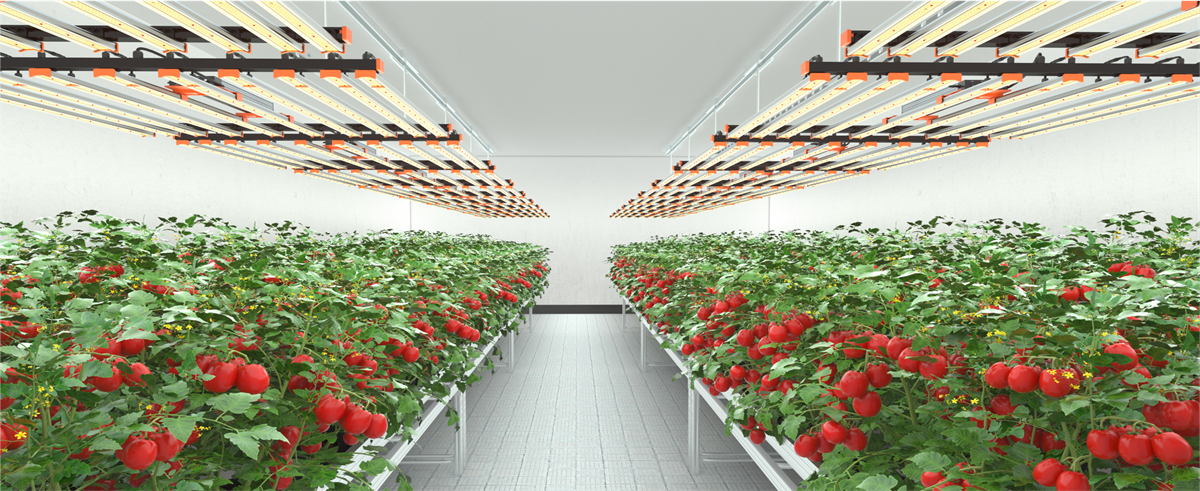
Why growers use red light
Red light is efficient for photosynthetic activity, which means it can help plants build biomass with less wasted energy. It also influences plant signaling, flowering behavior and canopy development. This is one reason many professional grow lights include dedicated red LEDs in addition to broad white LEDs.
For flowering and fruiting crops, a strong but balanced red component can support yield potential. For leafy greens, red light can contribute to growth rate, while blue light and white light help manage shape, color and quality.
Why red light alone is not enough
A red-only lamp may grow plants, but the result is often less balanced. Plants also need blue wavelengths for morphology, stomatal behavior and compact growth. White light improves visual inspection for workers and helps create a broad spectral base. In modern commercial fixtures, the best result usually comes from a carefully designed full spectrum rather than a single color.
How Agrilumia designs red light into fixtures
Agrilumia full spectrum fixtures use red wavelengths as part of a complete horticulture recipe. Depending on the product series, the design can include white diodes, 660 nm red, blue supplementation and customized spectrum options for OEM/ODM projects. The goal is not to chase one color, but to deliver stable PPFD, good crop quality and reliable long-term performance.
Buyer Checklist
What to check before choosing a red-enhanced grow light
A professional fixture should prove performance through full-system design, not only by listing one wavelength.
| Item | Why It Matters |
|---|---|
| Spectrum curve | Shows whether red light is balanced with blue and broad white wavelengths. |
| PPFD map | Confirms light distribution across the canopy. |
| Thermal structure | Protects red diode output and fixture life. |
| Dimming control | Allows growers to adjust intensity by crop stage. |
Recommended Products
Explore Agrilumia LED grow light solutions.
Four product links are randomly selected for each article visit, helping readers discover related grow light series and OEM support options.